# DocAligner: Automating the Annotation of Photographed Documents Through Real-virtual Alignment

## News
🔥 DocAligner is accepted by [Pattern Recognition](https://www.sciencedirect.com/science/article/abs/pii/S0031320325008520).
🔥 A comprehensive [Recommendation for Document Image Processing](https://github.com/ZZZHANG-jx/Recommendations-Document-Image-Processing) is available.
## Environment
```
conda env create -f environment.yml
```
The correlation layer is implemented in CUDA using CuPy, so CuPy is a required dependency. It can be installed using pip install cupy or alternatively using one of the provided binary packages as outlined in the CuPy repository. The code was developed using Python 3.7 & PyTorch 1.11 & CUDA 11.2, which is why I installed cupy for cuda112. For another CUDA version, change accordingly.
```
pip install cupy-cuda112 --no-cache-dir
```
## Training
1. Data preparation
* Use our provided script [synthv2.py](./data/DocAlign12K/flow_synth/synthv2.py) to synthesize training data, or directly download the [DocAlign12K]() dataset we used for training.
* Notably, to enhance the diversity of the synthetic data, we use an online manner for shadow synthesis. The 500 shadow background images we collected can be downloaded [here](https://1drv.ms/f/s!Ak15mSdV3Wy4ibRvLXIMbJoIzkpSpQ?e=mkiGBp).
* In `train.py`, set `data_path` to the path of the synthetic dataset. In `loader/docalign12k.py`, set `self.shadow_paths` to the path where the shadow images are located.
2. Training
```
bash train.sh
```
## Inference
1. Weight preparation:
* Put non-rigid pre-alignment module weights [mbd.pkl](https://1drv.ms/f/s!Ak15mSdV3Wy4ibRvLXIMbJoIzkpSpQ?e=mkiGBp) and hierarchical alignment module weights [docaligner.pkl](https://1drv.ms/f/s!Ak15mSdV3Wy4ibRvLXIMbJoIzkpSpQ?e=mkiGBp) to `checkpoint/`
2. Data preparation:
* Source and target images need to be put in `data/example`.
* The names of source captured images should end with `_origin`, while names of target clean images should end with `_target`.
* The names of paired source and target should be the same except for the different name endings.
* Generate some flow maps in the `data/DocAlign12K/forwardmap/` directory using `data/DocAlign12K/synthv2.py`, or download [existing ones(https://1drv.ms/f/s!Ak15mSdV3Wy4ibRvLXIMbJoIzkpSpQ?e=mkiGBp)]. This will facilitate the subsequent self-supervised learning step (Step 4).
3. Perform non-rigid pre-alignment
```
python ./data/preprocess/MBD/infer.py --im_folder ./data/example
```
4. Inference. Note that we offer 3 modes, which are
* 1: no self-supervision
* 2: self-supervised optimization for each image separately
* 3: self-supervised optimization for the whole dataset. For the vast majority of cases, Mode 2 works best but is very time consuming, mode 3 is a compromise between performance and efficiency.
```
python infer.py --mode 3 --im_folder ./data/example
```
5. Obtain final grid based on grid from step 2 and 3. Such final grid correlates the source target clean image toward the source captured image.
```
python tools/sum_backwardmap.py --im_folder ./data/example
```
6. Utilization of final grid .
* Annotation transform (COCO format): Please refer to `tools/annotate_transform.py`. We also provide a script for COCO data visualization: `tools/coco_visualize.py`.
* Dewarping: We provide a script for dewarping the source captured image based on the final grid: `tools/dewarp.py`
## DocAligner-acquired Dataset
The dataset mentioned in our paper, obtained using DocAligner, for document layout analysis, table structure recognition, illumination correction, binarization and geometric rectification tasks can be downloaded [**here**](https://1drv.ms/f/s!Ak15mSdV3Wy4iOdLD3VCxzSeC82mJg?e=afLUBP).
## Citation
If you are using our code and data, please consider citing our paper.
```
@article{zhang2025docaligner,
title={DocAligner: Automating the Annotation of Photographed Documents Through Real-virtual Alignment},
author={Zhang, Jiaxin and Zhang, Peirong and Cheng, Huiyi and Chen, Xinhong and Xu, Haowei and Ding, Kai and Jin, Lianwen},
journal={Pattern Recognition},
pages={112191},
year={2025},
publisher={Elsevier}
}
```
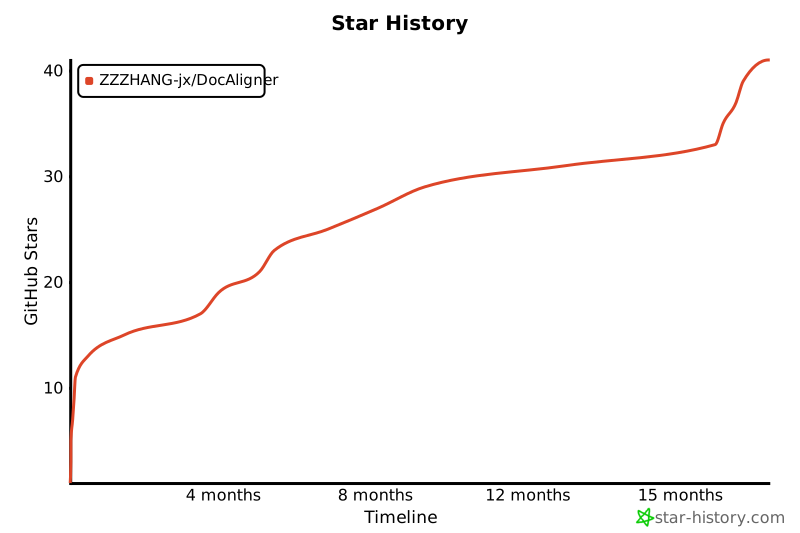
## ⭐ Star Rising
[](https://star-history.com/#ZZZHANG-jx/DocAligner&Timeline)
Some codes are based on [Marior](https://github.com/ZZZHANG-jx/Marior) and [GLU-Net](https://github.com/PruneTruong/GLU-Net). Thanks to all the authors for their great work.